
Books
Chander Pahar: the book, the film and the audio story
Bibhutibhushan's 1937 adventure novel, read through its own preface: what he borrowed from travellers' books and what he made up, how the 2013 film changed it, and which audio version to start with.
 Eshita Ghosh
In this post (4)
The book opens on a young man who does not want the job waiting for him. Shankar Roy Chowdhury is twenty, has just passed his F.A. exams, and his family's money has run thin enough that a job in a jute mill is the sensible future. He dreams of Livingstone and Stanley instead. Then a man who married into his village, now working in Mombasa, finds him a clerk's job on the Uganda Railway, and in 1909 Shankar is on his way.
The man who wrote that escape never made it himself. Bibhutibhushan Bandyopadhyay signed the preface to Chander Pahar at Barrackpore in Jessore on 1 Ashwin 1344, in September 1937, and he had not been to Africa. The geography and scenery of the book were taken from other people's travel books; the story and the people were his own, and he did it all from Bengal. Chander Pahar is a novel about wanting to leave, by a man who did his leaving on paper, and that may be why it has never stopped working on readers who are stuck somewhere themselves.
The book: an Africa built from travellers' books
The preface is short, and it is worth reading for how plainly he says what he did. Chander Pahar, he writes, is not a translation of any English novel, nor written in the shadow of any foreign story; the story and the characters are his own invention. To get the lie of the land and the look of it right, he used the books of a few famous travellers, and he names two: Sir Harry Johnston and Rosita Forbes. The monsters he explains too. The legends of the Dingonek and the Bunyip, he says, are still told in the forests of Zululand. The drawings and the cover were by the artist Binoy Basu, and the book carries a two-word dedication: খুকুকে দিলাম, for Khuku. You can read all of it, as printed in the 1945 edition, on Wikisource.
The borrowed geography shows in one place, and it is a lovely mistake. The preface calls the Richtersveld a famous mountain range of central Africa, and the book fills it with dense forest. The real Richtersveld is a dry country of rocky gorges in the north-western corner of South Africa, where the Orange River marks the border with Namibia, and its highest point is under 1,400 m. The mountains that European explorers actually tied to the old Mountains of the Moon, the source of the Nile in the geography of the Greek scholar Ptolemy, are the Rwenzori, on the border of Uganda and the Congo, snow-capped at over 5,000 m. For the reader, it hardly matters. The Africa in the book is the one a Bengali boy could build from a library, and that is a kind of truth too.
What happens, without the ending
Shankar survives a man-eater on the railway works and a black mamba at a lonely station on the veldt. There he takes in a sick Portuguese prospector, Diego Alvarez, who tells him about a yellow-diamond mine on the Mountain of the Moon, the friend he lost looking for it, and the creature the villagers say guards it, the Bunyip. Shankar resigns, and the two of them go in. That is as far as we will take you. The rest of the book belongs to the reader, and it is still frightening in the right places.
Chander Pahar
Bibhutibhushan Bandyopadhyay · Public domain in India; the 1945 edition was published by M.C. Sarkar and Sons, College Square, Calcutta
Fourteen chapters and an appendix. Printed editions are widely sold in Bengali bookshops; the scan of the 1945 edition, priced then at one rupee eight annas, is free to read.
The film, 2013: the Africa he never saw
Kamaleswar Mukherjee's Chander Pahar reached cinemas in West Bengal on 20 December 2013, produced by Shree Venkatesh Films, with Dev as Shankar and the South African actor Gérard Rudolf as Alvarez. It was shot in Kruger National Park, the Drakensberg and the Kalahari, and Wikipedia records it as the first Indian film shot extensively in South Africa. Four years later the same director and star took Shankar to South America in Amazon Obhijaan.
The film does the one thing the book could not. It shows you the real Africa, lions and all, and for a first-time viewer that is a thrill. It also takes away the book's secret, which is that the Africa was imagined. (A small complaint: a film cannot print a preface.) Watch the film for the scale; read or hear the book for the voice of a man describing a place he could only dream about. And then there is the title song.
 3:49
Chander Pahar title song, Arijit Singh
SVF
Music by Indraadip, from the 2013 film. We also put it in our long-weekend drives, for the red-soil stretch where the land starts to rise.
The audio story: where to start
If you grew up with the book and have not opened it in twenty years, listening is the easiest way back in. Mirchi Bangla's audio version runs five hours and fifteen minutes. Don't try it in one sitting. Take it an hour at a time over a week of commutes, or a little each night before sleep.
 5:15:29Play: Chander Pahar, Mirchi Bangla
Chander Pahar, Mirchi Bangla
Mirchi Bangla
5 hours 15 minutes: the Richtersveld, the Bunyip and the Mountain of the Moon. Start here.
When you finish, two more of his stories are on his page as Sunday Suspense episodes.
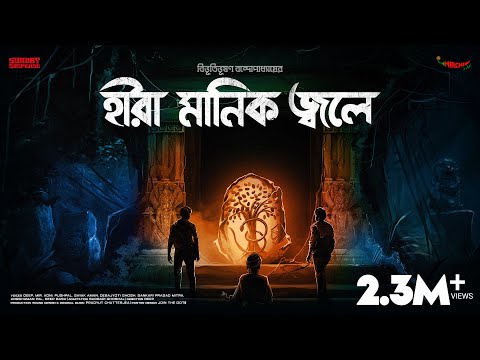 2:22:41Play: Heera Manik Jwoley, Sunday Suspense
Heera Manik Jwoley, Sunday Suspense
Mirchi Bangla
Another Bibhutibhushan adventure novel, read as a Sunday Suspense episode, 2 hours 23 minutes. The one to play next.
 2:04:54Play: Mismider Kabach, Sunday Suspense
Mismider Kabach, Sunday Suspense
Mirchi Bangla
A change of pace: a young detective, Sushil, on holiday in a relative's village, and a murder. 2 hours 5 minutes.
Shankar, in the end, did get out of the jute mill. Most of us did not, and that is fine; we have the book for that. Open it on Wikisource tonight, or press play from the start, and give it a week.
References (6)
- চাঁদের পাহাড় (1945 edition, scan and text), Wikisource. Checked 30 Sep 2026.
- Chander Pahar, Wikipedia. Checked 30 Sep 2026.
- Chander Pahar (film), Wikipedia. Checked 30 Sep 2026.
- Bibhutibhushan Bandyopadhyay, Wikipedia. Checked 30 Sep 2026.
- Richtersveld, Wikipedia. Checked 30 Sep 2026.
- Rwenzori Mountains, Wikipedia. Checked 30 Sep 2026.


Follow MoodKolkata
More posts like this, new stories and songs, as they come.