
Festivals
Kali Puja 2026: the date, the amavasya timing, and Kolkata's famous Kali pujas
Kali Puja falls on Sunday 8 November 2026, with the puja at midnight. Here are the amavasya times from two panjikas, why Bengal worships Kali on Diwali night, and where Kolkata goes.
In this post (6)
On the night of Sunday 8 November, most of India will light its lamps for Lakshmi and go to bed. Bengal will be waiting for midnight. The priests in the neighbourhood pandals will not start the main puja until the new moon is well into the night, and by then the lanes will smell of gunpowder and ghee, and the Shyama Sangeet from somebody's speaker will have been going round for hours.
The same dark night, the same lamps, and a different goddess. So why does Bengal give this night to Kali when most of India gives it to Lakshmi? The answer is younger than most of us assume, and it is the story underneath the date.
When is Kali Puja in 2026?
Sunday 8 November 2026, and both panjikas below agree on the day for Kolkata. Drikpanchang's Kali Puja page for Kolkata has the amavasya running from 11.27 am on Sunday to 12.31 pm on Monday 9 November. The Bisuddha Siddhanta panjika, which Bengal also buys as a printed almanac, has it a minute or two later, 11.29 am to 12.32 pm. A minute or two either way does not move the night.
| Day | What | Tithi, by drikpanchang |
|---|---|---|
| Sat 7 Nov | Bhoot Chaturdashi: fourteen greens at lunch, fourteen lamps at dusk | Chaturdashi from 10.47 am |
| Sun 8 Nov | Kali Puja, Dipabali; Diwali and Lakshmi Puja elsewhere | Amavasya from 11.27 am |
| Mon 9 Nov | The new moon ends at 12.31 pm; pratipada follows | Amavasya to 12.31 pm |
| Wed 11 Nov | Bhai Phota | Dwitiya, 2.00 pm Tue to 3.53 pm Wed |
Why the puja waits for midnight
A tithi keeps its own clock. It can begin at breakfast and end after lunch the next day, so every festival needs a rule for which calendar day it takes. Durga's Navami is decided by what is running at sunrise. Kali's is decided at midnight: the Bisuddha panjika says in so many words that the date is fixed by the nishitha-kala rule, which means the amavasya has to be running in the deep middle of the night. This year it is, on Sunday, with plenty to spare.
Drikpanchang narrows the nishita window to 51 minutes, from 10.55 to 11.46 pm. A family puja at home may keep that hour exactly. At a big barowari puja, with a queue down the road, people keep coming through the night. If you want to be at the moment itself, ask the committee what time their priest begins.
When the nishita puja begins in Kolkata, in your city
- Kolkata, all of IndiaSun22:558 Nov
- DhakaSun23:258 Nov
- LondonSun17:258 Nov
- New York, TorontoSun12:258 Nov
- San FranciscoSun09:258 Nov
- DubaiSun21:258 Nov
- SingaporeMon01:259 Nov
- SydneyMon04:259 Nov
10.55 pm IST on Sun 8 Nov, by drikpanchang for Kolkata. UK and US clocks will already be on winter time by then.
It was Lakshmi's night first
Here is the part that surprises people. In the sixteenth century Raghunandan, the Nabadwip scholar who laid down the rules for Bengal's rites, prescribed Lakshmi Puja for this amavasya and did not mention Kali at all. Bengali Wikipedia's history of the festival records this, and then a book of 1768, Kashinath's Kali Saparyasbidhi, which argues for worshipping Kali on this night. The scholar Sashibhushan Dasgupta read that argument the other way round: a writer does not argue so hard for a custom everybody already keeps.
So the Kali Puja we know is, by the standards of Bengal's festivals, young. Bengali Wikipedia records the tradition that Krishnananda Agamavagisha of Nabadwip, in the seventeenth century, was the first to worship Kali in an image he made himself; before him, devotees drew or engraved her yantra on a copper plate. In the eighteenth century Raja Krishnachandra of Nadia made the puja popular across his lands, and in the nineteenth, with Sri Ramakrishna at Dakshineswar and the city's rich families paying for bigger and bigger pujas, it grew into what we see now. Wikipedia's page on Kali Puja tells the eighteenth- and nineteenth-century part the same way.
The older night has not gone away, either. At Kalighat, Wikipedia records, Kali is worshipped as Lakshmi on this day. It is a small thing, and it is the most honest history lesson in the city: the new goddess took the old goddess's night, and the older temple kept a place for both.
The songs came from an accountant's ledger
Every Kali Puja night in Bengal is also a night of one poet. Ramprasad Sen was born around 1718 or 1723 and lived at Halisahar, up the river from Kolkata. The story everyone tells is that he worked as a clerk in a Kolkata household and filled the account book with songs to Kali, and that his employer, instead of sacking him, sent him home on a salary. Wikipedia marks it as a traditional account, and so do we. The record is firmer on the next part: Krishnachandra of Nadia made him his court poet and gave him the title Kaviranjan.
What he left is the tone of the whole genre. Ramprasad spoke to Kali as a son speaks to a mother who has kept him waiting, half in love and half in complaint, and the Shyama Sangeet singers of the last century, Pannalal Bhattacharya and his elder brother Dhananjay among them, sang him to every Bengali household with a radio. These are the recordings we would put on while the pandal lights come up.
 5:28
Mon Re Krishi Kaaj
Atlantis Music
Ramprasad's own, as Atlantis Music credits it, sung by Dohar. The mind as a field left unploughed: a farmer's song, and a hard one. Five and a half minutes.
 4:59
Thakte Dis Re Maa
Keshab Dey
Keshab Dey's recording, the most played Shyama Sangeet we carry at more than 43 million YouTube views by September 2026. Five minutes, and a voice that does not hurry.
 5:40
Ekbar Nacho Maa
DOHAR FOLK
Dohar again, with Kalikaprasad Bhattacharya's name on it: the percussion and the folk chorus make it the one for a crowded lane. Five and a half minutes.
 5:38
Bhebe Dekh Mon
Aalo | আলো 🪔
Arijit Chakraborty for Aalo. Quieter, and it sits in our Bhor mood as well as Pujo, which tells you when to play it: late, when the crowd has thinned.
Kolkata's famous Kali pujas, briefly
This year's committee notices are not out yet, so here is the short version: two temples and two pandal towns.
Kalighat
South Kolkata
The older of the two temples, and the one where Kali is worshipped as Lakshmi on this night. The temple was named in the fifteenth-century Manasar Bhasan; the building you queue for was finished in 1809 under the Sabarna Roy Choudhury family, by Wikipedia's account. Thousands come on this day, Wikipedia notes, so expect a long queue.
- Nearest metro
- Kalighat, Blue Line
- On the night
- Queues from the evening; go early or after midnight
Dakshineswar
North of the city, on the Hooghly
Rani Rashmoni's temple, built between 1847 and 1855, where Ramakrishna was priest from 1856. The goddess here is Bhavatarini. Ramakrishna's room is still there, in a corner of the courtyard facing the river.
- Nearest metro
- Dakshineswar, Blue Line
- Built
- 1847 to 1855, by Rani Rashmoni
Barasat and Naihati
North 24 Parganas
The pandal towns. Wikipedia calls Barasat's the biggest Kali Puja in West Bengal; the ranking we leave to the towns themselves. Naihati is on the same list of Kali Puja towns. Both are a train ride out of the city.
- From Kolkata
- Sealdah suburban trains to Barasat or Naihati
- On the night
- Last trains back are crowded; check the time before you set out
If you are staying in
For a Bengali in Bengaluru or Birmingham, the puja is a video call and a lamp on the windowsill. Mirchi Bangla's Times of Puraan tells the goddess's own stories in short episodes; start with how Kali came to be, then Rani Rashmoni's.
 12:44Play: Maa Kali-r Utpotti
Maa Kali-r Utpotti
Mirchi Bangla
The birth of Kali, from the Kali Katha series on Times of Puraan. Thirteen minutes.
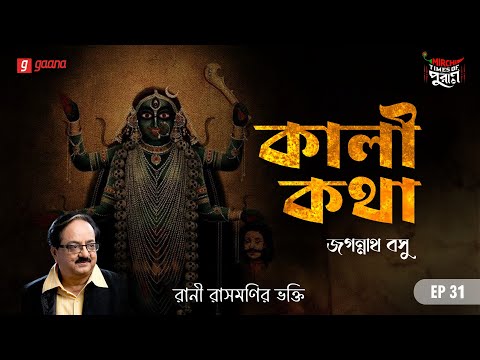 17:44Play: Rani Rashmoni-r Bhakti
Rani Rashmoni-r Bhakti
Mirchi Bangla
Rani Rashmoni's devotion, from the same series. Eighteen minutes.
The rest of the series begins at episode one, and the mythology shelf holds more. Then turn the speaker up and let the Pujo mood run until someone asks you to turn it down.
References (9)
- Bengal Kali Puja 2026, Kolkata, drikpanchang. Checked 30 Sep 2026.
- Diwali Puja Calendar 2026, Kolkata, drikpanchang. Checked 30 Sep 2026.
- Kali Chaudas 2026, Kolkata, drikpanchang. Checked 30 Sep 2026.
- Bhai Dooj 2026, Kolkata, drikpanchang. Checked 30 Sep 2026.
- Kali Puja, Wikipedia. Checked 30 Sep 2026.
- কালীপূজা, Bengali Wikipedia. Checked 30 Sep 2026.
- Ramprasad Sen, Wikipedia. Checked 30 Sep 2026.
- Dakshineswar Kali Temple, Wikipedia. Checked 30 Sep 2026.
- Kalighat Kali Temple, Wikipedia. Checked 30 Sep 2026.
Pictures: Kali at Amadpur, West Bengal, in white shola work. On Kali Puja night the goddess is worshipped at midnight, not at dawn: Ratul Pal, Unsplash
Just inNew stories from the channelsWhat the Bengali story channels have just put up, played from their own YouTube.See the stories


Follow MoodKolkata
More posts like this, new stories and songs, as they come.