
Food
What's in the Durga Puja bhog: khichuri, labra and the day-by-day offerings
What goes on a Durga Puja bhog plate, from khichuri and labra to chutney and payesh, what Saptami, Ashtami, Navami and Dashami add, and why no two pujas agree.
In this post (5)
The khichuri you wait for at the pandal has been in front of the goddess before it reaches your leaf. That is all bhog means: food offered to the deity, which then becomes blessed food for everyone else. The dishes are ordinary ones: khichuri (rice cooked with dal), a mixed vegetable, a sweet chutney, payesh (rice cooked in milk). What makes them bhog is the order in which they are served.
What is bhog, and how is it different from prasad?
Bhog is the Bengali form of the Sanskrit bhoga, which means enjoyment. Wikipedia's article on bhoga explains that food offered to a deity is held to be consumed by the deity and is then taken by devotees as prasad. In West Bengal the word bhog is used for the consecrated food handed out at big festivals such as Durga Puja, and the same article draws the line most of us grew up with: bhog is a whole meal, while prasad is a small amount and not meant to feed you.
It also names the plate most Kolkata Bengalis would draw if asked: khichuri with a semi-dry vegetable, a sweet tomato chutney and payesh, served on plates made of sal leaves pinned with small twigs, which are thrown away afterwards.
What's on a bhog plate
| Dish | What it is | Worth knowing |
|---|---|---|
| Khichuri | Rice and dal cooked together, often with vegetables | In the medieval Manasamangal, Shiva asks Parvati to cook him moong dal khichuri with coconut water |
| Labra | A mix of vegetables cooked in oil with light spice | A Bengali Hindu dish, East Bengal's above all, named in the Chaitanya Charitamrita, where Chaitanya asks for it |
| Tomato chutney | A sweet chutney of tomato | Named as part of the usual bhog on Wikipedia's bhoga page |
| Payesh | Rice cooked in milk with sugar | The sweet end of the plate |
| Luchi | Bread of maida, deep-fried in oil or ghee | Offered as bhog at every puja, Durga Puja included, and eaten with labra or alur dom |
| Bhaja | Fried vegetables | At the older Sovabazar Rajbari the bhog is several kinds of bhaja and sweets |
Two of those lines deserve their sources. Bengali Wikipedia's khichuri article has the khichuri detail, and we like it because it puts the dish in the goddess's own kitchen: Parvati is the Uma who comes home for the Puja. The labra detail is from its article on labra, which traces the name to the Sanskrit alabu, lists pumpkin, sweet potato, potato, man kochu, raw banana, banana stem, banana flower, brinjal and flat beans as its vegetables, and says it was still a wedding dish in the seventies and no longer is, but stays on as niramish bhog in many temple households and in home kitchens.
Bengali Wikipedia's luchi page records that luchi is offered as bhog at every puja, Durga Puja included, and is then taken as prasad, and that at Durga Puja it goes with labra or alur dom. The English page adds that luchi is eaten through Durga Puja, Lakshmi Puja and Kali Puja with dal and potato curry.
Which day gets which bhog?
There is no one menu for each day. Each puja follows its own family, temple or committee, and what goes to the goddess on Ashtami in one house can be unthinkable in the next. The table below keeps to what the pujas themselves have recorded, with Kolkata's dates for 2026.
| Day | Date | What is recorded |
|---|---|---|
| Saptami | Sun 18 Oct | Belur Math closes the day's puja with bhog and arati |
| Ashtami | Mon 19 Oct | Belur Math closes with bhog again; Wikipedia records a food offering to the goddess after the Sandhi Puja |
| Navami | Tue 20 Oct | Homa and bhog |
| Dashami | Wed 21 Oct | Belur Math offers a shital bhog, a cooling offering, before the visarjan rite; the Sabarna Roy Choudhury family's Atchala puja offers panta bhat |
Belur Math's own account of its Durga Puja says the Saptami and the Ashtami puja each end with bhog and arati, and that Dashami morning begins with a brief puja, shital bhog and arati. It does not list what goes into the shital bhog. Navami's bhog and homa are in Wikipedia's Durga Puja article, which also places a food offering after the Sandhi Puja on Ashtami.
The rest shows how much customs differ. Wikipedia's article on panta bhat, rice soaked overnight in water, records that on Vijayadashami the Sabarna Roy Choudhury family's Atchala Durga in Kolkata is offered panta bhat with a soup of grass pea (khesari), fried kochu leaves, a fish jhol and a chutney of chalta. Fish, then, is no stranger to a bhog. If you grew up with a niramish Puja, that is the line to show whoever tells you there is one right way.
On Ashtami, anjali first, then the queue for bhog
Bhog is served only after the puja, so the day's anjali comes first. This year Ashtami tithi ends at 10.51 am on Monday 19 October and Sandhi Puja runs from 10.27 to 11.15 am, by drikpanchang's Kolkata reckoning; the whole timetable is in our Durga Puja 2026 day by day. If your para's puja follows the Gupta Press or Benimadhab Sil panjika, Saptami and Ashtami each come a day earlier, Saptami on Saturday 17 and Ashtami on Sunday 18 October, and the Sandhi Puja runs from 7.26 to 8.14 am on Monday. At a mandap that follows the Gupta Press panjika, anjali is over by about 7 am on Monday. Pujas on that reckoning do not all agree on Navami and Dashami. We would give anjali early and then ask at the puja when the bhog is served, because every committee sets its own hour. The notice at the mandap is what counts.
 5:05
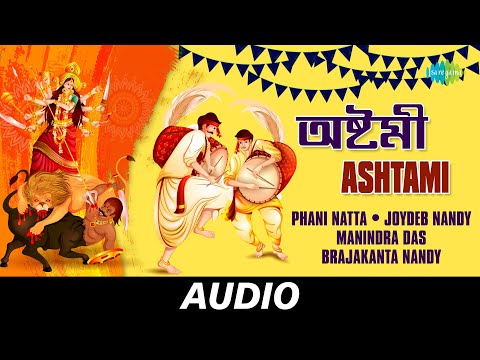
Ashtami, Pujar Dhak
Saregama Bengali
Five minutes of Saregama's Ashtami dhak. If you are cooking the khichuri at home, far from any pandal, this is the sound the kitchen is missing.
A story for after the meal
Bengali fiction has its own famous cook. Bibhutibhushan Bandyopadhyay's 1940 novel Adarsha Hindu Hotel follows Hajari Thakur, the cook at a hotel near Ranaghat station, who dreams of a hotel of his own and needs two hundred rupees to open it, as Wikipedia's summary of the novel puts it. We carry it in two parts, read on Goppo Mir-er Thek.
 2:33:24Play: Adarsha Hindu Hotel, Part 1
Adarsha Hindu Hotel, Part 1
Mir Afsar Ali
Mir Afsar Ali's channel, two hours and 33 minutes. Long enough for the afternoon after a bhog lunch, and it is about a man who cooks for a living and cares how it is done. Part 2 runs two hours and 14 minutes.
 3:35:44Play: Sunday Suspense Classics: Bhog and Shodh
Sunday Suspense Classics: Bhog and Shodh
Mirchi Bangla
Mirchi Bangla, two stories by Avik Sarkar, about three and a half hours together. It is here for its title, which shares this post's word, and it is filed with our ghost stories, so it is for the evening, not the lunch.
More of Bibhutibhushan is on his author page, and the rest of the Puja week's music plays in the Pujo mood. For the hour after bhog, when nobody wants to move and everybody has an opinion, there is the Adda mood.
References (13)
- Bhoga, Wikipedia. Checked 28 Sep 2026.
- Bhog (ভোগ), Bengali Wikipedia. Checked 28 Sep 2026.
- Durga Puja (দুর্গাপূজা), Bengali Wikipedia. Checked 28 Sep 2026.
- Durga Puja, Wikipedia. Checked 28 Sep 2026.
- Durga Puja, Belur Math (Ramakrishna Math and Ramakrishna Mission). Checked 28 Sep 2026.
- Panta bhat, Wikipedia. Checked 28 Sep 2026.
- Khichuri (খিচুড়ি), Bengali Wikipedia. Checked 28 Sep 2026.
- Labra (লাবড়া), Bengali Wikipedia. Checked 28 Sep 2026.
- Luchi (লুচি), Bengali Wikipedia. Checked 28 Sep 2026.
- Luchi, Wikipedia. Checked 28 Sep 2026.
- Adarsha Hindu Hotel, Wikipedia. Checked 28 Sep 2026.
- Durga Puja calendar 2026, Kolkata, Drik Panchang. Checked 28 Sep 2026.
- Sandhi Puja 2026, Kolkata, Drik Panchang. Checked 28 Sep 2026.


Follow MoodKolkata
More posts like this, new stories and songs, as they come.